In this article
- Teltonika's growth model stalled
- What is a custom workshop, and when do you choose one?
- How we built the session at Teltonika
- What changed in the leadership team?
- Why the existing governance no longer fit
- Next step for Teltonika
- Our analysis: What does this mean for middle management?
- How do you apply this in your own organization?
- Frequently asked questions
Teltonika's growth model stalled
Teltonika grew for years on strong engineering, product development, and commercial power. The company beat its targets year after year. That encouraged a focus in which success was measured by sales.
The tide turned over the past three years. Market saturation, international growth, and rising product complexity put the business model under pressure. Product and sales each optimized from their own perspective. Targets were sharp, short-cycle, and output-driven, but they lacked clear direction and coherence.
The new CEO drew a conclusion that is often missing at this stage. The problem was not that goals were missing. The problem was that the goals said nothing about the future. That led to the core question: How do you organize a young leadership team to lead the next growth phase?
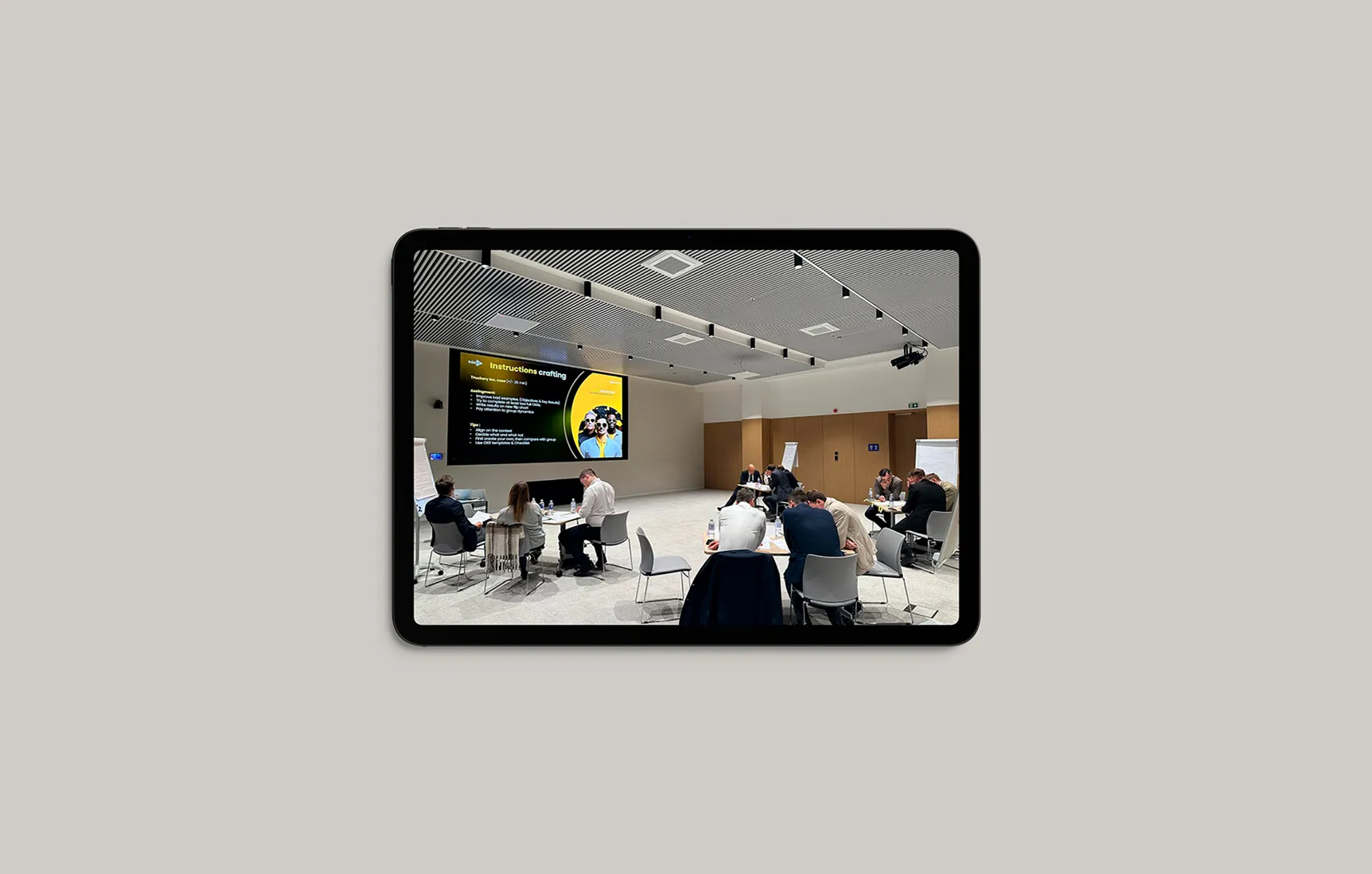
As experts in Performance Management, we handle more questions like this. We also know that more may surface along the way, and we want to adapt our guidance accordingly. So, together with the CEO, we chose a two-day custom workshop.
What is a custom workshop, and when do you choose one?
We design a custom workshop specifically around the question of one organization. We set the content, the group, and the working formats in advance, based on the situation and the participants. Compare that with a training program like OKR training, which works the other way around and offers fixed content to a selected group.
At Teltonika, the leadership team was multidisciplinary and young. A fixed program would only half fit each role. That is exactly the moment you choose the custom option.
How we built the session at Teltonika
The workshop focused on three main questions:
- Where do we want to stand in three to five years?
- Which strategic choices does that require?
- How do we translate those choices into goals that steer behavior, not only results?
We used Objectives & Key Results (OKRs) as a thinking framework instead of a reporting process. That distinction matters. A measurement tool records what you already do. A thinking framework forces you to choose what you will do. For an organization that always hits its targets, that second step is usually the hardest.
Organizations do not arrive at this type of conversation on their own, and that fits a wider trend. A Gartner survey of 805 HR leaders in July 2024 found that three-quarters consider their managers overloaded by an increasing number of tasks. Another 69% said that leaders and managers are not well equipped to lead change. Thinking ahead and actively steering and acting on it as a manager is under pressure.
What changed in the leadership team?
The most important insight concerned the meaning of success. Consistently beating your targets is a strong indication that you are on the right course. It can also mean the targets sit too close to the existing model. An organization that always wins on its own playing field postpones the question of a new playing field.
The conversation shifted from "how do we get more this year" to "which organization are we building". The team steered less on historical performance and more on future positioning. It named trade-offs explicitly instead of dividing them implicitly across departments.
Responsibility for direction became shared across the whole team rather than remaining with the CEO. We saw a similar shift earlier at SSC-ICT (BZK). It is a valuable moment, and it shows the leadership team has started the change.
Why the existing governance no longer fit
Once the direction was on the table, a question came up that nobody had asked beforehand: does our way of steering still fit this?
The answer was no, and that was widely shared. Teltonika's meeting structure and management information were built on the old model. They were set up to track whether sales were on schedule. They were not set up to track whether the organization is developing in the chosen direction.
That is a different kind of question. Whether you hit revenue this quarter shows up in a dashboard. Whether you stand in the right place in three years shows up nowhere. Same meetings, same numbers, same frequency: the focus always lands on daily operations rather than on long-term direction. Operational urgency beats strategic urgency, week after week.
So Teltonika started work on a new governance and meeting model that separates the two. Operational steering covers running the business: delivering, hitting targets, adjusting. Policy and strategic steering cover growth and organizational development: where are we moving, which choices do we make, and which signals tell us whether it works. Two separate conversations, two separate rhythms, two separate sets of information.
For us, this is the most important result of the sessions. Not because of a concrete deliverable, but because organizations rarely conclude on their own that their own steering mechanism is the problem.
Next step for Teltonika
The next phase asks for more concrete work. Teltonika has to translate the long-term vision into multi-year objectives, with a clear link between the product roadmap and the commercial strategy. The new governance and meeting model has to be set up. Inspection has to happen at the strategic level, not only on quarterly numbers.
Our analysis: what does this mean for middle management?
A governance model does not sit with the executive team alone. It is the agenda of your Monday meeting, the columns in the report you deliver, and the questions that land on your desk. When the executive team decides that operational and strategic steering must be separated, little changes at the top and a lot of changes for you.
Recognize this? Then you are in the same situation Teltonika was in before the sessions:
- In your meetings, 90% of the time is spent on what went wrong and 10% on where you are going.
- You report numbers that nobody bases a decision on.
- You can explain the goal, but not which choice lies behind it.
- Any priority you set can be overruled next week by an urgent operational issue.
- Your team asks why something matters, and you get no further than: that is the target.
This is not a communication or planning problem. It is a governance problem that lands on your desk as an execution problem.
The numbers point the same way. A 2025 Gartner survey found that only 32 percent of mid- to senior-level leaders felt the last change they led was well adopted by employees. In 2026, 66 percent of the managers surveyed said their main task is managing people, not delivering organizational goals. That is what happens when the governance model focuses only on your operation.
That has two consequences:
- When the translation fails, the cause often sits higher in the organization.
- At the same time, you can start the conversation about it yourself.
At Teltonika, the insight came from the CEO. In most organizations, you see it earlier because you are the one who has to walk into a team with an unusable goal.
How to raise this conversation as a middle manager
Take your own meeting agenda from the past three months. Count how many agenda items covered running the business and how many covered development. Do the same with your reporting: how many of those numbers led to a decision in that period? Put that next to the strategic ambition you were handed. The gap shows itself. That is the evidence you use to support the conversation.
You do not have to ask for extra time, capacity, or people. Aim for a separate moment to discuss direction, using information other than operational numbers. This is the same step the Teltonika leadership team took, only at department level.
For that situation, we have the workshop Leadership in the Middle, which focuses on setting priorities amid conflicting interests and political dynamics, as well as the role of informal leaders in change.
How do you apply this in your own organization?
The questions from the sessions with Teltonika also work at department level. Start here:
- Set the horizon before you formulate goals. One year, three years, or five years. Pick one.
- Limit the number of goals to what you can retell in one sentence.
- Name the choice behind each goal. What do we stop doing because of this?
- Test each goal against behavior. Does something change in how people work, or only in what you measure?
- Separate your meetings. One moment for running a business, one moment for direction. Do not put them back-to-back on the same agenda, because then all focus goes to operations.
- Look critically at your management information. Which numbers lead to a decision, and which are only reported? Cut the second category or replace it.
- Put the people at the table who have to carry the trade-off, not only the colleagues who come up with it.
Want to tackle this in one session with your own team? We help with Custom Workshops and Organizational Coaching.
Frequently asked questions about leadership and goals
What is the difference between operational steering and strategic steering?
Operational steering covers running the business: delivering, hitting targets, and making short-term adjustments. Strategic steering covers the direction of the organization: which choices you make and whether you are developing in the intended direction. They need different information, a different rhythm, and usually a separate meeting.
Why separate operational and strategic steering?
Because operational urgency always beats strategic urgency when both sit on the same agenda. A missed target asks for action today. A direction three years out does not. If you do not separate the two, strategic steering fades into the background.
How do you know whether your management information still fits your strategy?
Go through last quarter's reporting and check which numbers led to a decision. Numbers that are only reported steer nothing. If none of your numbers indicate the direction you chose, you are still measuring with the old model.
What is the difference between targets and OKRs?
A target sets the result you want to reach, so you steer toward the output. An OKR sets the change you want to achieve, so you steer in the right direction and make visible which choices are required.
How do you translate an organizational strategy into team goals?
By making the strategic choice explicit first, and formulating the goal after that. Without that choice, a team goal becomes a slice of an annual target, and a team cannot derive priorities from that.
Why is it a risk to consistently hit your targets?
Because it confirms that the existing model works. That makes the question of whether the model still fits less urgent, while that question is exactly what determines the next growth phase.
How do you convince your executive team that governance has to change?
With your own agenda and reporting as evidence. Show how much meeting time goes to running the business, how many reported numbers lead to a decision, and put that next to the strategic ambition. Then ask for a separate moment to discuss the strategic direction.
Can a custom workshop also work for middle management?
Yes. This is Performance runs sessions for management teams, for teams, and for middle management separately. The workshop Leadership in the Middle is designed for that management layer.
Last updated at August 18, 2026